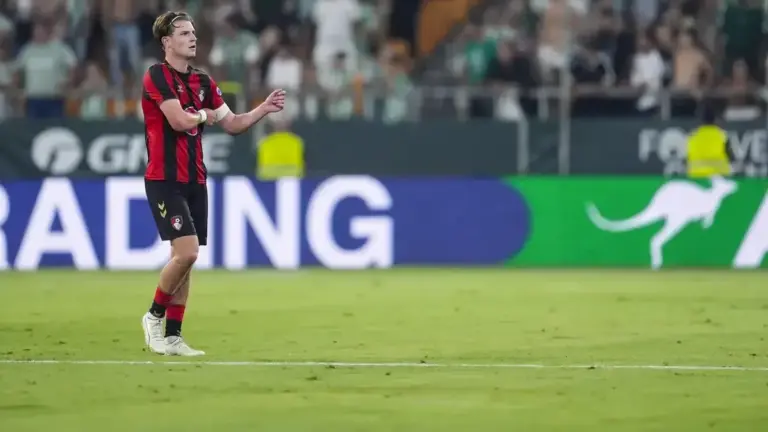
Real Madrid’s renewal of Vinícius Júnior has finally had a number attached to it, and it is a big one: around €48 million a season, all in, according to Spanish reporting. The Vinicius Junior salary question had been the last real unknown left over from a negotiation that dragged through most of 2026, and the figure now being quoted puts the Brazilian level with Kylian Mbappé at the top of the Madrid pay scale.
What the Vinicius Junior salary figure actually says
The claim comes from journalist and analyst Ramón Álvarez de Mon, whose estimate was carried by Defensa Central and relayed in English by Madrid Universal. His wording matters as much as the number.
“The club pays €48 million per season and they will have to accept that this is the new salary scale for their top players,” he said.
Two things are worth pulling out of that sentence. The first is “the club pays” — this is presented as the total annual cost of Vinícius to Real Madrid, not the sum that lands in his bank account. The second is “the new salary scale”, which is the genuinely significant part. A single contract has just reset the ceiling, and every subsequent negotiation at the Santiago Bernabéu will be conducted with that ceiling in the room.
None of this has been confirmed by Real Madrid, who do not publish player salaries and never have. It should be read as an informed estimate from a reporter who covers the club’s finances, not as a leaked payslip.
Why €48m is not the same as €48m in wages
It is worth being precise here, because gross-cost figures tend to get flattened into “he earns X” headlines within about an hour of publication.
An all-in annual cost of that size typically bundles together basic salary, the amortised portion of any signing bonus, image-rights payments and the employer’s social security and tax obligations, which in Spain are not trivial. The take-home number is materially lower than the accounting number. What the €48m tells you is what the line in Madrid’s books looks like — which is precisely what a club finance analyst would be interested in.
That distinction does not make the figure less striking. It simply means the honest version of the story is “Vinícius is now Madrid’s most expensive player to employ, alongside Mbappé”, rather than any tabloid-friendly weekly wage.
How Madrid made room on the wage bill
The obvious follow-up question is whether the club can absorb it. Álvarez de Mon’s answer was unambiguous.
“Madrid has its wage bill under control in relation to its revenue; it’s a very low percentage,” he said — a reference to the ratio UEFA and LaLiga both watch closely, and one Madrid have historically been more disciplined about than most of their peers.
The mechanism behind that discipline has been attrition at the top of the pay structure. David Alaba, Luka Modrić and former captain Dani Carvajal have all come off the wage bill in recent years, and Dani Ceballos’ contract was terminated by mutual agreement in June. Those were not small salaries. Removing several of them in a short space of time is what created the room to hand Vinícius a substantially improved deal without the total figure moving in an alarming direction.
This is the unglamorous half of squad building, and it is the half Madrid tend to get right. The renewal did not happen because the club found extra money. It happened because the club had already spent two summers clearing space for it, in much the same measured way they are now approaching Thibaut Courtois’ contract talks.
The warning attached to the deal
Álvarez de Mon did not present the situation as risk-free. His caveat was blunt: “They cannot afford to let their guard down, or they’ll get themselves into trouble.”
The logic is straightforward. A salary ceiling only functions as a ceiling if the club treats it as one. Set the top of the scale at €48m, and the next elite player through the door — or the next elite player already inside it asking for parity — begins his negotiation from that number rather than from the one it replaced. Do that three or four times and a wage bill that currently sits at a comfortable percentage of revenue stops being comfortable very quickly.
Vinícius’ deal is reported to run to 2032, which at least means Madrid will not have to revisit this particular conversation for a long time. The exposure is not him. The exposure is everybody who follows.
Bellingham is the next number on the list
Which brings the conversation, inevitably, to Jude Bellingham. The Englishman is 23, has been central to the team since the day he arrived, and is the most obvious candidate to test whether the new scale is a ceiling or a floor. We looked at the state of Bellingham’s own renewal situation when it last surfaced, and the Vinícius figure has just moved the goalposts on it.
That is not a criticism of either player. It is simply how wage structures work at clubs where several footballers can all reasonably claim to be the best in the squad. Madrid’s challenge over the next 18 months is to keep the top of the pyramid narrow — two players at the summit, not five — and that will require saying no to somebody with a decent argument for hearing yes.
What Madrid are actually paying for
Set the accountancy aside for a moment, because the football case for the renewal was made rather emphatically this week, and not in the way anybody expected.
Vinícius did not score in the 2-1 Champions League win over Inter Milan — Mbappé and captain Federico Valverde got the goals. What he did instead was recover nine balls, six of them in his own half, a tally no Real Madrid attacker had matched in the competition at the Bernabéu since Gonzalo Higuaín against Zenit in December 2008, per Opta data cited by Mundo Deportivo. Both Madrid goals arrived from high turnovers in the Inter half.
José Mourinho, who has spent his first weeks back in charge asking for exactly that kind of work from his forwards, said afterwards that Vinícius “is not at his peak, but he has all my respect; he is working harder than ever”. It is a notably warmer public assessment than the one the Bernabéu itself offered on the night, when sections of the crowd made their impatience audible inside the first quarter of an hour.
That is the tension a €48m-a-season player now carries. He is being paid like a match-winner and is currently contributing like an excellent presser — two shots against Inter, neither on target. Mourinho’s bet, and by extension the club’s, is that the goals return to a player who has already added the running.
What happens next
Nothing, in the immediate sense. The contract is signed, the money is committed, and Madrid head into the September international break top of the early La Liga table with a Champions League win already banked under a new manager.
The longer game is the one to watch. Real Madrid have just told the market what their best players are worth, and markets have a habit of listening. The Vinicius Junior salary is not a problem in isolation — it is a benchmark, and benchmarks are only as useful as the discipline of the people who set them.
For now, Los Blancos have kept a 26-year-old Ballon d’Or contender at the club until 2032, absorbed the cost without straining the accounts, and watched him spend a European night doing the dirty work his new manager demanded. On that evidence, the number is defensible. Stopping it from becoming the starting point for everyone else is the harder task.