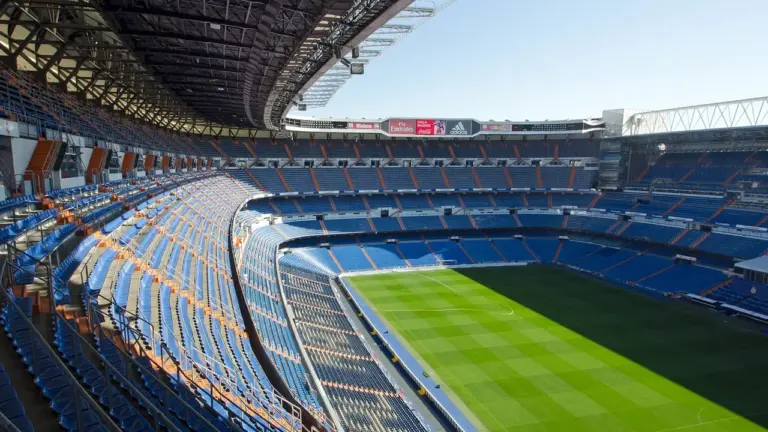
The Santiago Bernabéu stadium is the most recognisable building in world football, and after a rebuild that ran for the better part of five years it barely resembles the ground Madridistas queued outside a decade ago. This is the essential guide: capacity, history, what the renovation changed, how to get there and what the Bernabéu Tour actually gets you.
Santiago Bernabéu stadium capacity
Real Madrid list the current capacity at just over 83,000 — all seated, all covered, and stacked into a famously steep four-tier bowl that puts the upper rows closer to the pitch than the raw number suggests. That makes it one of the largest club grounds in Europe, though not the biggest in Spain: Barcelona’s Camp Nou holds more.
It used to take far more. In the standing era of the 1950s and 1960s, crowds well beyond 100,000 crammed in for European nights, and those attendance figures will never be matched now that UEFA and LaLiga require all-seater venues. What Los Blancos lost in bodies they have gained in acoustics: the new roof traps sound inside the bowl, and the difference on a big Champions League night is obvious to anyone who watched games there before 2020.
From Nuevo Chamartín to the Bernabéu
The ground opened on 14 December 1947 as the Nuevo Estadio Chamartín, built on the Paseo de la Castellana at what was then the northern edge of the city. Real Madrid marked the occasion with a 3-1 win over Portuguese side Os Belenenses.
In 1955 it was renamed in honour of Santiago Bernabéu Yeste, the club president who had pushed the project through and who went on to preside over the era of five consecutive European Cups. He held the presidency from 1943 until his death in 1978 — 35 years that turned a well-supported Madrid club into the institution the rest of Europe measures itself against.
Every generation since has redrawn it. Roofs went on, tiers went up, the terraces went away, and the exterior went from bare concrete to the curved steel skin that now lights up in club colours.
What the renovation changed
The most recent rebuild — reported to have cost in the region of €1bn, financed by a long-term loan rather than out of the transfer budget — added four things that actually matter to supporters.
- A retractable roof. It closes over the pitch, so rain is no longer a factor for anybody in the stands.
- A 360-degree video screen. A continuous ribbon of screen runs the full way round beneath the upper tier, replacing the old corner boards.
- A retractable pitch. The surface can be lowered and stored in trays beneath the stadium, which is what allows the bowl to host concerts and events without ruining the grass.
- The steel-slat facade. The exterior is now a wraparound shell that doubles as a lighting rig, which is why the building looks completely different on television.
For a visiting fan the upshot is better sightlines, no weather, more concourse space, and a stadium busy enough between fixtures to stage NFL games and concerts.
How to get to the Santiago Bernabéu
The address is Avenida de Concha Espina 1, in the Chamartín district, roughly four kilometres north of Puerta del Sol. The simplest route is the Metro: line 10 has a station called Santiago Bernabéu that surfaces directly outside the ground. Nuevos Ministerios and Cuzco are walkable alternatives if line 10 is heaving after the final whistle, which it invariably is.
Plenty of city bus routes run along the Castellana, and Chamartín mainline station — the terminus for many long-distance and regional services — is two Metro stops away. Driving is not recommended: matchday road closures around the Castellana are extensive and the stadium car park is not for general public use.
Allow more time than you think you need. Concourse queues before a Champions League kick-off are long, and the club operates ticket-holder-only zones outside the turnstiles on the biggest nights.
The Bernabéu Tour
The stadium museum and tour is one of the most visited paid attractions in Madrid, and on a non-matchday it is the reason most travelling fans come to Chamartín at all. The route takes in the trophy room — the European Cup collection is the centrepiece, and seeing it in one cabinet is genuinely startling — plus the dressing room, the tunnel, the pitchside benches and the press room.
Tours run daily outside matchdays and the hours immediately around fixtures, slots are timed, and booking ahead in summer is sensible. Tickets are sold through Real Madrid’s official website, and the city tourism board at esMadrid lists opening arrangements alongside the rest of the Castellana if you are building a day around it.
Finals and famous nights
The Bernabéu has staged four European Cup or Champions League finals — 1957, 1969, 1980 and 2010 — more than any other club ground in the competition’s history. Real Madrid won the first of them themselves, beating Fiorentina in 1957. In 2010, fittingly for the current era, it was José Mourinho who lifted the trophy there with Inter, days before he was appointed Madrid manager for the first time.
It also hosted the final of the 1964 European Championship, won by Spain, and the 1982 World Cup final, won by Italy. In 2018 it staged something stranger still: the second leg of the Copa Libertadores final between River Plate and Boca Juniors, relocated from Buenos Aires, which briefly made the Bernabéu the venue for the biggest game in South American club football.
What to know before matchday
Kick-off times in Spain land late. LaLiga typically confirms them a couple of weeks out, and Champions League slots are either 18:45 or 21:00 CET, so check before booking flights; our Real Madrid fixture guide tracks the confirmed dates as they arrive.
For the football itself, this is a squad worth the trip. Mourinho is back in the home dugout for a second spell, Federico Valverde wears the captain’s armband, and Kylian Mbappé, Jude Bellingham and Vinícius Júnior are all in their prime in the same forward line. For what Mourinho’s return means for European nights at the ground, we covered that in our piece on his Champions League homecoming.
One last piece of advice from anyone who has done it: stay in your seat at full time. The walk down from the upper tier is slow, the Metro is slower, and the Bernabéu after a win is a far better place to spend ten extra minutes than a platform at Nuevos Ministerios.