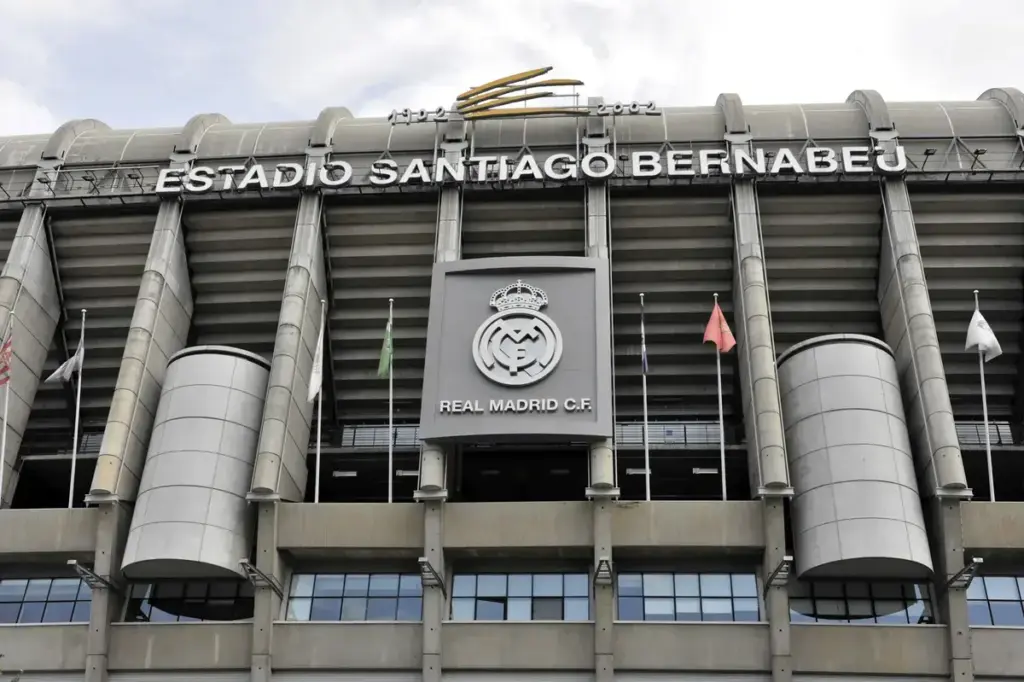

Real Madrid’s most valuable asset this week is not a footballer.
While the first team prepares to host Malaga on Sunday, a planning decision moving quietly through Madrid’s city hall could hand the club a windfall of more than €180 million and the Real Madrid Valdebebas site sits right at the centre of it.
What the Real Madrid Valdebebas rezoning actually does
According to Mundo Deportivo, the city government led by mayor Jose Luis Martinez-Almeida is reclassifying 448,000 square metres of buildable land at Valdebebas that belongs to Real Madrid, switching it from sporting use to lucrative commercial use.
In practical terms, that means the ground around the club’s training complex could carry hotels, office blocks, a hospital and a private university rather than more pitches. Under the new plan, the buildable area set aside for sporting facilities would be cut back to the 89,000 square metres the club has already used for the Ciudad Real Madrid. Everything else becomes developable in a far more profitable way.
The project was unveiled in May at an event attended by club president Florentino Perez and regional leader Isabel Diaz Ayuso. It is branded the Madrid Innovation District — already nicknamed Madrid’s Silicon Valley — and the plan is a large technology campus. Final approval is not expected until 2027.
The numbers behind the 180m euro figure
The valuations reported in Spain are what make this a story rather than a planning footnote. Per Mundo Deportivo, citing Voz Populi, the consultancy Savills values Real Madrid’s Valdebebas landholding at around €360 million once the reclassification goes through.
A document seen by El Pais breaks that revaluation down into three parts: €40.7 million for the sporting land, €133.9 million for the private amenity land, and €185.5 million for the tertiary commercial land. Add those together and you arrive at the Savills headline. The club’s potential income from the operation is put at more than €180 million.
The plot currently carries 360,000 square metres of buildable capacity, all earmarked for private sporting facilities, and a decision in July lifted that ceiling towards 532,000. The reclassification is the second half of the move: first more capacity, then permission to use it profitably.
Madridistas have seen this film before
If the shape of the deal feels familiar, that is because it is. The comparison is 2001, when a council rezoning let Real Madrid sell the old Ciudad Deportiva on the Paseo de la Castellana — a sale that transformed the club’s finances and effectively bankrolled the first galactico era.
Nobody at the Bernabeu is promising a repeat, and the context is different. But the pattern is the one that has underwritten Madrid’s economic model for a quarter of a century: the club’s real estate, not just its shirt sales, is a strategic asset. It is the same instinct that produced the redeveloped Santiago Bernabeu, now a year-round events venue as much as a football stadium.
Why it matters on the pitch
The temptation is to file this under boardroom trivia. That would be a mistake, because Real Madrid’s spending power in the transfer market is a direct function of exactly this kind of income.
Los Blancos have had an expensive summer under Jose Mourinho, adding Yan Diomande, Marc Cucurella, Denzel Dumfries, Bernardo Silva and Ibrahima Konate, and Emilio Butragueno has since indicated the squad is closed. A nine-figure land revaluation changes nothing before Monday’s deadline, but it is the sort of balance-sheet strength that lets a club refuse to sell a 20-year-old forward Arsenal keep asking about.
It also fits a wider picture. Real Madrid were confirmed earlier this month as the most valuable brand in world football for a third straight year, and the club has spent the past decade converting institutional advantages into commercial ones. Valdebebas is the next line in that ledger.
The caveats worth keeping
Two of them, and they matter. None of this is signed off: the general plan still has to complete its passage, and 2027 is the earliest realistic approval date. And the €180 million is a projection of potential income drawn from a consultancy valuation, not money in the club’s account — a technology campus is only worth what tenants eventually pay for it.
Still, the direction of travel is clear enough. Real Madrid own a large piece of land on the edge of the city, the council is preparing to let them build far more profitably on it, and the club has a well-rehearsed history of turning that exact situation into transfer-market firepower. Madridistas who lived through 2001 will recognise the opening scene.








Comments.
Loading comments…