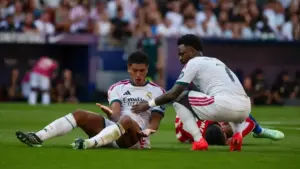
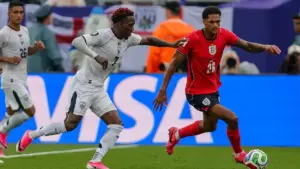
Real Madrid have won five of six this season and sit three points behind Barcelona, yet the loudest conversation in Spain this weekend was not about the goals.
It was about the Real Madrid pressing problem that Santiago Canizares laid out on Cope after Saturday’s 4-1 win over Rayo Vallecano, in language Madridistas will not enjoy reading.
Canizares: what the forwards do without the ball is “appalling”
The former Valencia and Spain goalkeeper began with a compliment. “Madrid have one thing, the best quality a team can have, which is effectiveness. There is no doubt about that,” he said, quoted by Mundo Deportivo. Then came the warning: “If a team wants to be the best in Europe, it has to be able to handle more registers.”
His target was the front line. “When they do not have the ball, what the strikers do is appalling,” Canizares said. “It is contagious. One looks at the other, the other looks at the other, and thinks, well, if he is not moving, neither am I.”
The consequence, in his telling, is structural rather than cosmetic. “The team splits, the midfielders have to drop back and stick to the defence, and any team can create chances against Real Madrid. This is not competitive and it has to be sorted out. If you do not do it all year, then on the day you actually have to do it, you might not do it properly.”
Why the Real Madrid pressing problem is now a chorus
What makes it harder to wave away is that three other former internationals arrived at the same place from different directions on the same morning. Abelardo, speaking on Movistar, pointed at the selection. “When you play with such offensive players – Diomande, Vinicius, Mbappe, Bellingham himself – you have to work at everything, and when the team splits and you have a side like Rayo who are brave and want the ball, obviously you suffer,” he said, per Mundo Deportivo. He added that Madrid “sometimes lose control of matches”, citing the Inter Milan game as well as Rayo, and that Mbappe or one of the others then “solves the game and covers up defensive shortcomings”.
Alkorta framed it as balance: enormous going forward, a problem the moment the ball is lost. Poli Rincon, on Cope, aimed higher up. “The one who has to react is the manager,” he said, as reported by Mundo Deportivo, arguing that Jose Mourinho “does not want to have the ball” and that Madrid will keep winning while being resultadista – one pundit’s view of a coach with three European Cups, and worth reading as such.
The second-half pattern, in numbers
There is evidence underneath the noise. Only twice this season have Real Madrid produced a better second half than first: away at Espanyol and at home to Real Sociedad, the opening two league games. In the four matches since, every second half has been worse than the first, Mundo Deportivo notes. Against Rayo they were three goals up and cruising at the break, then conceded to Sergio Camello, needed saves from Thibaut Courtois and were whistled by their own stadium until Arda Guler came off the bench and changed the game.
Mourinho got there first
The manager did not hide from any of it. “I define today as a 45-minute match. It finished after 45 minutes, there is nothing more to it,” Mourinho said afterwards. “I knew the team did not have the strength, physical or mental, to play the second half the way they played the first.” He pointed to a hard midweek against Inter and to Jude Bellingham running on empty for the closing ten minutes.
Alvaro Carreras, who won the penalty for the first goal and scored the second, put the players’ side of it to Real Madrid TV: “It is difficult to sustain 90 minutes at one hundred percent intensity.” Mourinho sent on Marc Cucurella late specifically to help him defensively.
Which is the honest version of the argument. Nobody at Valdebebas is pretending the second halves have been good – the disagreement is whether fatigue explains them or excuses them. Tuesday night at Elche will not settle it. The Metropolitano on 20 September might.