At a glance
- Real Madrid have officially opened disciplinary proceedings against Federico Valverde and Aurélien Tchouaméni following a training ground incident.
- The club’s internal regime allows for sanctions ranging from salary suspension to dismissal, depending on how the offence is classified.
- Valverde has been ruled out for 10 to 14 days after being diagnosed with head trauma, adding medical weight to an already serious case.
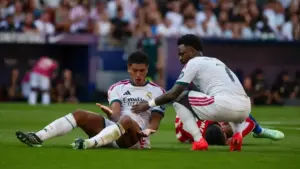
Real Madrid have confirmed the opening of disciplinary proceedings against Federico Valverde and Aurélien Tchouaméni following an incident during first-team training. This sets in motion a formal internal process that could carry significant consequences for both players.
The club issued an official statement confirming the proceedings. Also, they stated that any resolution would only be communicated once the relevant internal procedures had been completed. What those procedures involve – and where they could lead – is now the central question hanging over the Spanish giants.
How the internal disciplinary regime works at Real Madrid
According to COPE journalist Melchor Ruiz, the club is expected to apply its internal disciplinary framework alongside the formal proceedings already announced. That framework operates on a tiered classification system, and the outcome depends entirely on how the incident is categorised.
The first step is establishing the facts: what happened, in what sequence, and who bears responsibility. Once that is determined, the club must decide whether the actions constitute a serious offence or a very serious offence under its internal rules. That distinction is not semantic – it determines the range of punishment available.
A serious offence can carry a suspension of employment and salary for between three and ten matches. A very serious offence raises that range to between eleven and twenty matches. In the most extreme cases, the internal framework also allows for disciplinary dismissal. However, that outcome remains at the far end of the spectrum and would be unprecedented for players of this profile.
How far can Real Madrid disciplinary action go after the training clash
The process is not automatic, and Real Madrid are not obliged to apply the harshest sanction available. The framework gives the club discretion. What it does not give the club is an easy exit from the situation.
Ruiz also reported that the internal regime allows for broader sporting consequences in cases where conduct is deemed severe enough, including the possibility of a future sale on grounds of professional misconduct. That is a different category of consequence altogether – one that would move this beyond a disciplinary matter and into a question of long-term squad planning.
Real Madrid also published a medical report confirming that Valverde was diagnosed with head trauma and must rest for ten to fourteen days. Reuters, citing club sources, reported that Valverde suffered a head cut after a clash with Tchouaméni. Valverde himself later issued a statement denying that Tchouaméni had struck him, saying the injury occurred when he hit a table during the argument. Reconciling those accounts is now part of what the disciplinary process must resolve.
Why the timing makes this a defining moment for Real Madrid
This is not a routine dressing room incident. It arrives at a moment when Real Madrid are already under pressure following Champions League elimination, a string of injuries, and a LaLiga season that has drifted away from them. Barcelona are now on the verge of winning the title. With El Clásico approaching as a final and largely symbolic test.
In that context, how the club handles Valverde and Tchouaméni matters beyond the two players involved. A response that is too lenient risks undermining authority at a moment when the dressing room needs direction. A response that is too severe risks fracturing a squad that still has games to play.
Real Madrid’s internal rules give the club the tools to act firmly. What this moment demands is that they use them wisely.